
Project
CORRIDOR MANAGEMENT PLAN
About the California Route 66 Corridor Management Plan
California Historic Route 66 Association partnered with the Bureau of Land Management to create a Corridor Management Plan. This comprehensive document outlines strategies to protect and enhance the intrinsic qualities along the roadway. It is a requirement for a National Scenic Byway.
Needles to Barstow (CMP) has been prepared in accordance with Paragraph 9 of Federal Register, Vol. 60, No. 96, Thursday, May 18, 1995 (referred to as the Interim Policy) in order for the routes to be considered for nomination as National Scenic Byway from the California border east of Needles, California, generally following Interstate Route 40, US Route 95, Goffs Road and National Trails Highway to Barstow, California.
The route was designated by the State of California as Historic Route 66 in 1991, under Assembly Concurrent Resolution No.6 – Relative to Route 66 (filed with Secretary of State July 11, 1991). The state designation provides the eligibility of the route to be considered for designation as an All-American Road or National Scenic Byway by the Federal Highway Administration under the Interim Policy guiding that program.
According to the policy, “A corridor management plan, developed with community involvement, must be prepared for the scenic Byway corridor proposed for national designation. It should provide for the conservation and enhancement of the Byway’s intrinsic qualities as well as the promotion of tourism and economic development. The plan should provide an effective management strategy to balance these concerns while providing for the users’ enjoyment of the Byway. The corridor management plan is very important to the designation process, as it provides an understanding of how a road or highway possesses characteristics vital for designation as a National Scenic Byway or an All-American Road.”
Based on guidance provided by the Federal Highway Administration, this corridor management plan has been organized to document three core elements that must be addressed as part of the nomination process:
- Significance either regionally or nationally of the Intrinsic Quality(s) along the travel route that merit national designation
- Planning to support the preservation, enhancement and promotion of the Intrinsic Quality(s) along the travel route
- Providing for a quality visitor experience; and sustainability in the form of community and organizational support to continue to preserve, enhance and promote the travel route.
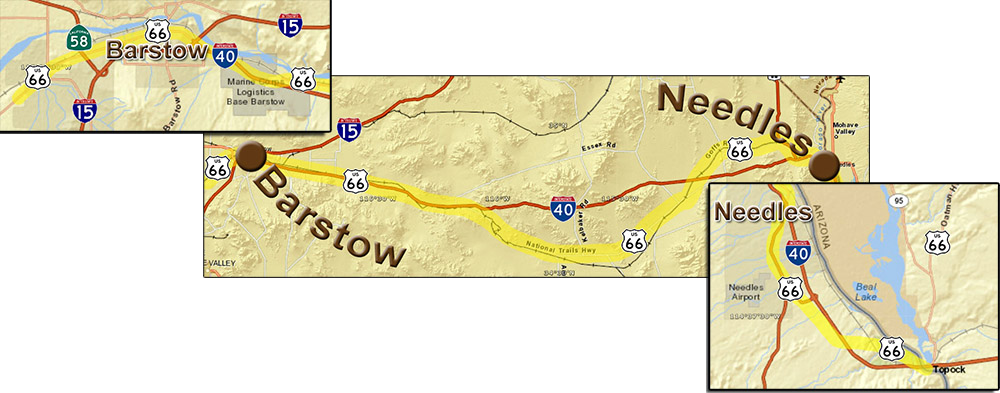
Map of Corridor
Here is a map showing the extent of the Corridor Management Plan. It extends all the way from the Colorado River (Arizona State line) in the east to the western city limits of Barstow in the west.
The Completed Plan
The Corridor Management Plan was developed with extensive citizen input, both through the contributions of an Ad Hoc Planning Committee and through extensive public outreach efforts in support of the development of the CMP, as discussed further in Chapter 2.
Alternatively, you may download the document in the following sections.
The CMP is organized into chapters to make it easier to ascertain the core elements and the FHWA interim policy, both noted above.
Chapter 1
Introduction: The overarching purpose of the CMP is to support designation of the Route 66 corridor between Needles and Barstow as a National Scenic Byway or All-American Road and guide the management of the route for heritage-tourism based economic development.
Chapter 2
Planning Context: Documenting the complex interagency and non-governmental management responsibilities across the desert corridor and the public outreach efforts to guide the development and implementation of the plan.
Chapter 3
Qualities of Historic Route 66: What makes this section of Route 66 significant? Why is it important?
Chapter 4
Stewardship: Preserving historic sites and heritage and minimizing potential visual intrusions to the travel experience.
Chapter 5
Enhancing the Visitor Experience: Enhancing visitor infrastructure to support economic growth and sustainable tourism.
Chapter 6
Visitor Safety and Roadway Experience: Increasing safety and roadway infrastructure to enhance the driving experience in a manner sensitive to historic context.
Chapter 7
Marketing: Developing current, consistent, and accurate information to position the route and surrounding attractions as a primary destination for target audiences.
Chapter 8
Implementation: Building an organizational structure to implement recommended management strategies. Followed by Appendices I and V.
The Corridor Management Plan recognizes the significant challenges that must be overcome to successfully manage the route for heritage tourism—a highly competitive funding environment, serious limitations on agency personnel who might otherwise contribute more professional time, and economic hardship facing communities in the corridor and beyond. Rather than step away and let this nationally significant resource lay fallow, the CMP recommends expansion of existing partnerships and a collaborative management approach to help Route 66 communities capture the spirit that shaped Route 66 in the first place—that same optimistic spirit many Route 66 travelers had in the road’s heyday—the fascination with going west and living one’s dreams. Why not dream of a reinvented Route 66?